Shamanic Healing Practitioner Certification
The Gold Standard in Shamanic Mastery. 100% Self-Paced. 100% Private.
Master the ancient skill-set of Shamanic Healing through a rigorous curriculum designed for the independent professional.
12-Module Curriculum
Developed by Guzalia Davis - Siberian Ancestral Healer | NLP Master | Hypnotherapist
This is not a "hobbyist" course. This curriculum is the culmination of decades of clinical practice and ancestral Siberian lineage. I have removed the fluff, the theatrics, and the "spiritual tourism" to provide a streamlined, high-level system for serious practitioners.
This isn't a program that teaches you to perform rituals and repeat prayers. You'll learn the actual clinical and energetic mechanics of shamanic healing and why the work works, so you can adapt it to any client, any belief system, any situation that doesn't match the textbook.


The 100% Independent Study Model
To respect our students' demands for convenience, time flexibility, and privacy, this program is delivered now in a 100% self-directed, self-paced format.
A Note on How This Program Runs: This training no longer requires live attendance or interaction. Earlier videos or classes still circulating may reference a Facebook group, weekly meetings, or live classes - those belonged to the first runs of our training. What you're enrolling in today is a private, self-paced path with optional 1-on-1 support (details below).
The learning portal is designed to protect you from overwhelm and ensure that enough time is given for your own healing and transformation, not just learning. New modules release weekly, and every module stays open for the life of your enrollment. Nothing closes behind you. Move gently, and return to any module as needed.
Total Autonomy: You own your schedule and your progress entirely.
Support is Always Available: I remain available by email throughout your training, and phone calls can be scheduled when needed. You are never without a way to reach me, you simply won't be interrupted by mandatory check-ins.
This Training Is for You If:
You Learn by Doing: This program is built on theory, demonstration, direct experience, and practice. You won't just learn about shamanic healing; you'll experience each technique as a student before you ever facilitate it for a client.
You Value Clinical Depth: You want the actual skill-set of shamanic trance and energetic intervention, not just rituals.
You're Ready to Build, Not Just Learn: You can begin using each skill and resource with real clients as soon as you complete the module it comes from, not in some unforeseen future. Your practice can grow alongside your training.
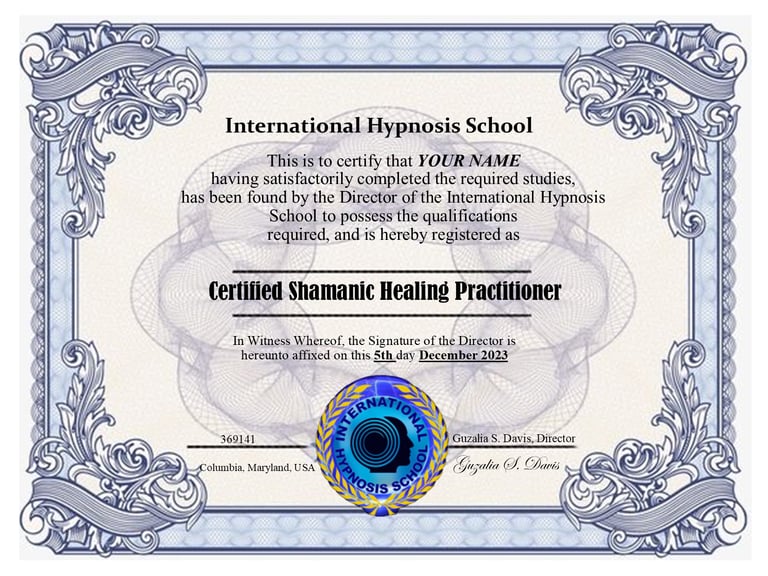
Upon Completion, You'll Hold Seven Professional Certifications:
Certified Shamanic Healing Practitioner
Certified Shamanic Soul Journey Facilitator
Certified Shamanic Soul Retrieval Facilitator
Certified Shamanic Energy Healing Practitioner
Certified Meditation Facilitator
Certified Grounding Teacher
Certified Dreamwork Specialist
That's seven credentials from one training - most programs in this field hand you one. Each is standalone enough to build a service, a workshop, or an entire practice around on its own, which means you have seven different directions to build in, and the freedom to choose which ones fit the practice you actually want to run.
This is designed for real work.
Every skill in this curriculum is built for real client work from the moment you learn it, not theory to be filed away until some future "readiness." As you move through each module, you can begin offering that specific service to clients immediately. You don't wait twelve modules to start building, your practice can grow in step with your training.
Seven certifications also means seven ways to adapt.
A practice built on one narrow skill set is fragile. If one thing stops working (a platform changes, a market shifts, a client base moves on) you have nothing to pivot to. A practice built on seven is resilient. You can specialize in soul retrieval one season and energy healing the next. You can package these credentials differently for different audiences (clinical clients, spiritual seekers, corporate wellness, other practitioners) without retraining from scratch every time the market moves.
This is a business model built into the certification itself: seven interchangeable, combinable skill sets that let you build a practice around your life, not the other way around, and adjust that practice as often as you need to, for as long as you're in this work.
The Curriculum: 12 Modules of Transformation
Module 1 — Foundations of Shamanic Practice
Shamanic world model, theory, and framework that everything after this rests on.
Module 2 — Grounding
The non-negotiable skill beneath every other technique in this curriculum. You'll leave this module certified to teach it.
→ Certified Grounding Teacher
Module 3 — Shamanic Energy Healing
Cord cutting, energetic clearing, and an introduction to womb healing. This is the entry point into hands-on energetic intervention. You'll leave this module ready to facilitate energy healing for your clients → Certified Shamanic Energy Healer
Module 4 — Hands-On Healing
The applied techniques: direct energetic intervention through touch and traditional healing practice.
Module 5 — The Trance Suite
A full mapping of meditation states and trance methodology — the mechanics, not just the experience. You'll leave this module ready to lead your clients → Certified Meditation Facilitator
Module 6 — Shamanic Initiation
The threshold work: what initiation actually is, and your first introduction to soul journey and soul retrieval before you practice either.
Module 7 — Soul Journey & Soul Retrieval
The full protocol, in depth — facilitation from start to finish.
→ Certified Soul Journey Facilitator, Certified Soul Retrieval Facilitator
Module 8 — Dreamwork & Shadow Work
Where the unconscious becomes workable material, awake or asleep.
Module 9 — Spirit Animals, Power Animals & Shape-Shifting
Totem work and shape-shifting practice, building direct relationship with non-human allies.
Module 10 — Seasonal Rites & Archetypal Trancework
The wheel-of-the-year rites, plus Archetypal Trancework with Baba Yaga - myth used as a working structure, not a story, teaching you how you can work with any archetype.
Module 11 — Submersion Into the Earth
Journeys into the inner and hollow Earth, the god pantheons, and passage to Avalon. The deepest descent work in the curriculum.
Module 12 — The Shamanic Death Ritual
The closing rite. Integration, completion, and the ritual that marks the practitioner you've become.
Every module includes video, audio, and written tresoucres, plus healing sessions you experience firsthand, for your own transformation as well as your training.
Your Support Structure
Here's exactly what's available to you:
Email support, ongoing, throughout your enrollment. Don;t hesitate to email me with your questions.
Phone calls can be scheduled when something needs a real conversation.
Two optional, student-initiated 1-on-1 Zoom sessions:
These are optional, initiated by you. Simply email me, letting know that you are ready to meet on Zoom.
Orientation Consultation (1 hour), at the start. Most students come to this training because they want to build a healing practice. This session is where we map that from day one: your path through the material, and the model of the practice you're building toward.
Closing Strategy Session (1 hour), at completion. A focused look at your business model and how your new skills fits into it.
Bonus: Business Bootcamp. This is designed to be worked through during your training, not saved for after; it's how you get clear on what kind of practice you're building and start building it in real time, alongside your modules.
🔔 How to Begin Your Training
Enrollment is fully automated to give you immediate, 24/7 access to the training vault. Please follow these steps carefully to ensure a seamless experience:
Secure Your Seat: Click the enrollment link below to be redirected to our secure Podia learning portal.
Select Your Path: Choose between the streamlined One-Time Investment or the Monthly Installment Plan.
Instant Vault Access: Upon successful payment, you will be redirected to your student dashboard. Do not wait for an email. Your training materials are available the second your transaction is complete.
Whitelisting & Logistics: You will receive an automated system receipt. Please ensure guzaliadavis@gmail.com and podia.com are added to your "Safe Senders" list to ensure you receive future curriculum updates.
Professional Support: Should you encounter a technical login issue, please contact support via the dashboard.
What is Included:
1-year access to all 12 Shamanic Training Modules.(Materials designated as 'Downloadable' are yours to keep permanently once saved to your personal device during your enrollment year.)
Scripts, manuals, forms - ready to be used in your work with clients.
Professional Certification (issued upon successful completion of the curriculum and full payment).
Peace of Mind: No hidden fees, no "upsells."
By clicking "Enroll Now," you acknowledge that you have read and agree to our [Terms of Service], specifically our No-Refund Policy for digital assets and our Professional Conduct Agreement.
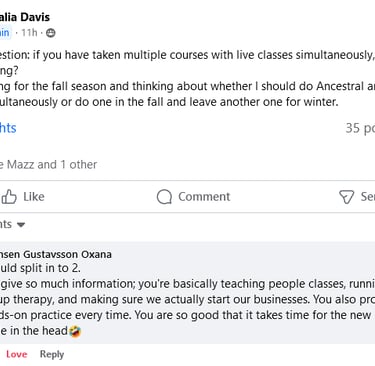
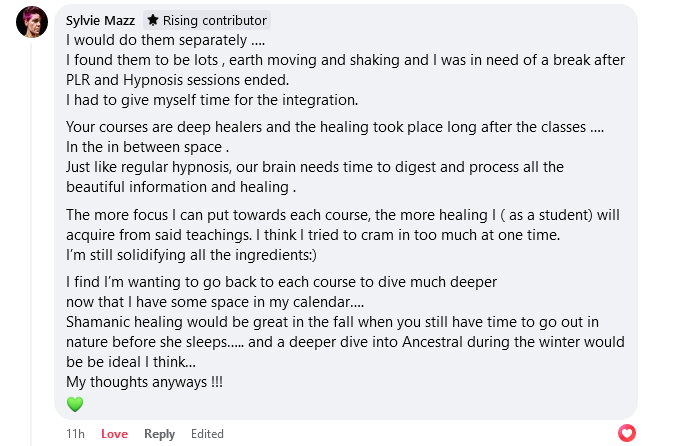
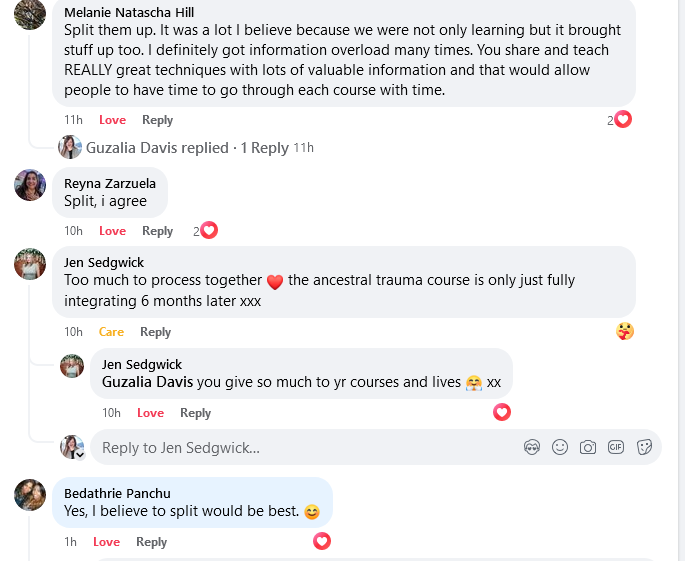
See what our students have to say about the intensity of the training:
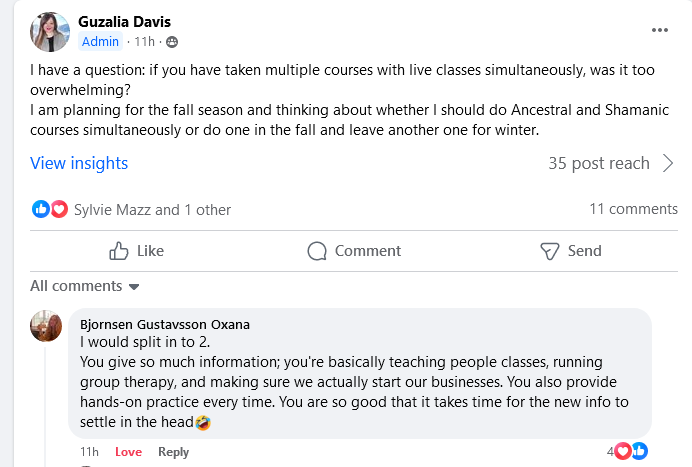
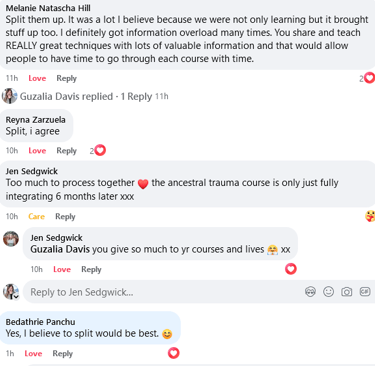

Testimonials
Annie Latta
Shamanic Healing
www.puresoulhypnosis.com

Reyna Zarzuela
Hypnosis and Shamanic Healing
Carmel, Indiana, USA
COHOBA THERAPEUTIC SERVICES
Susan Watson
Perfect Solutions Coaching Psychotherapy, Anxiety, Emotions, Trauma
Edinburg, England

Feedback
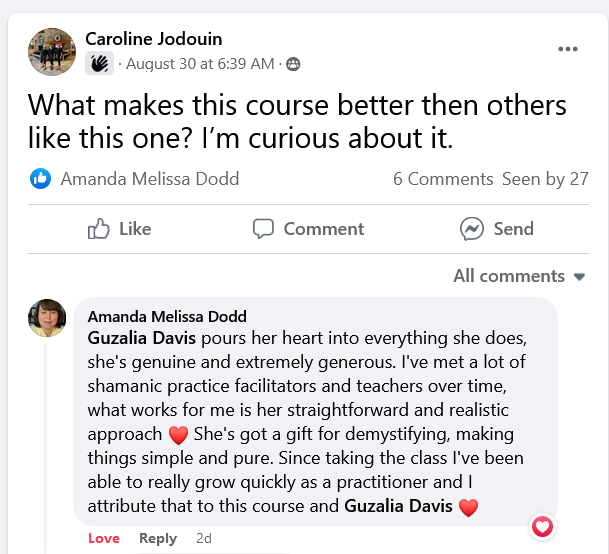
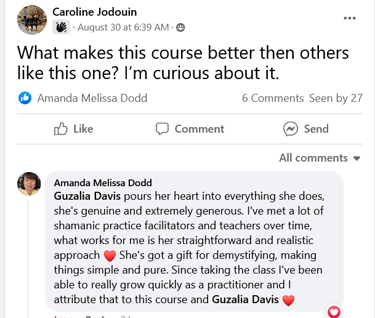
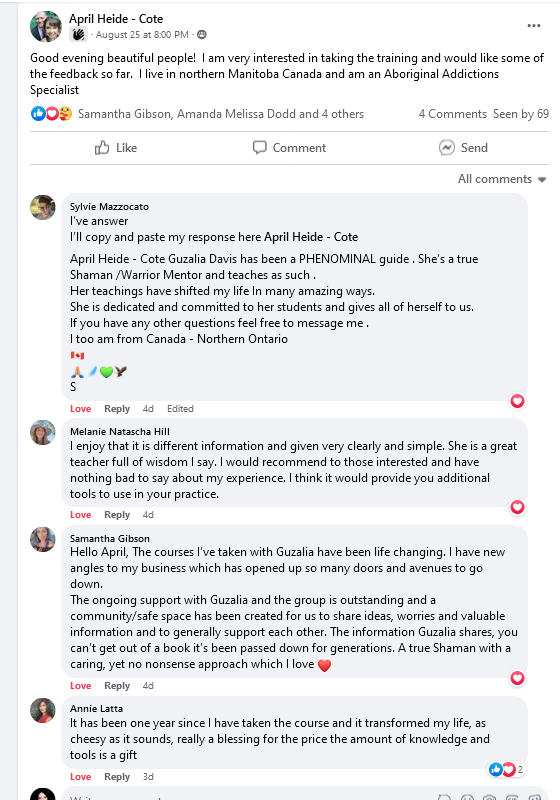
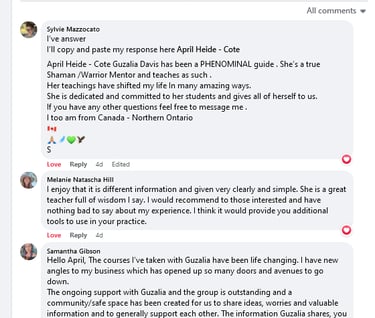
Happy students

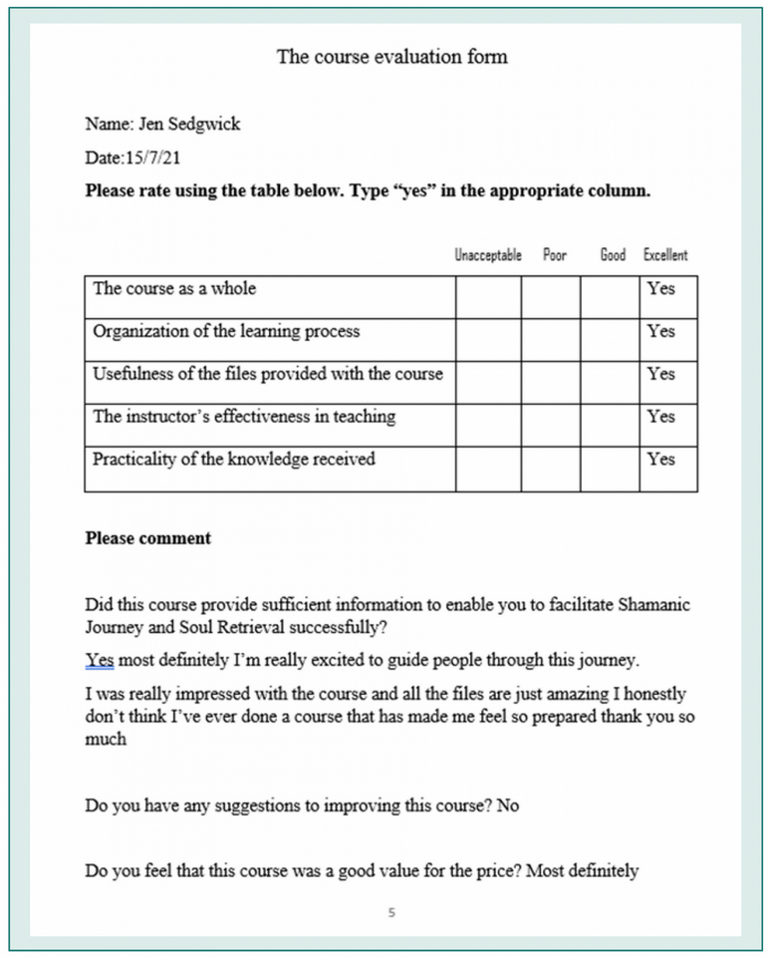
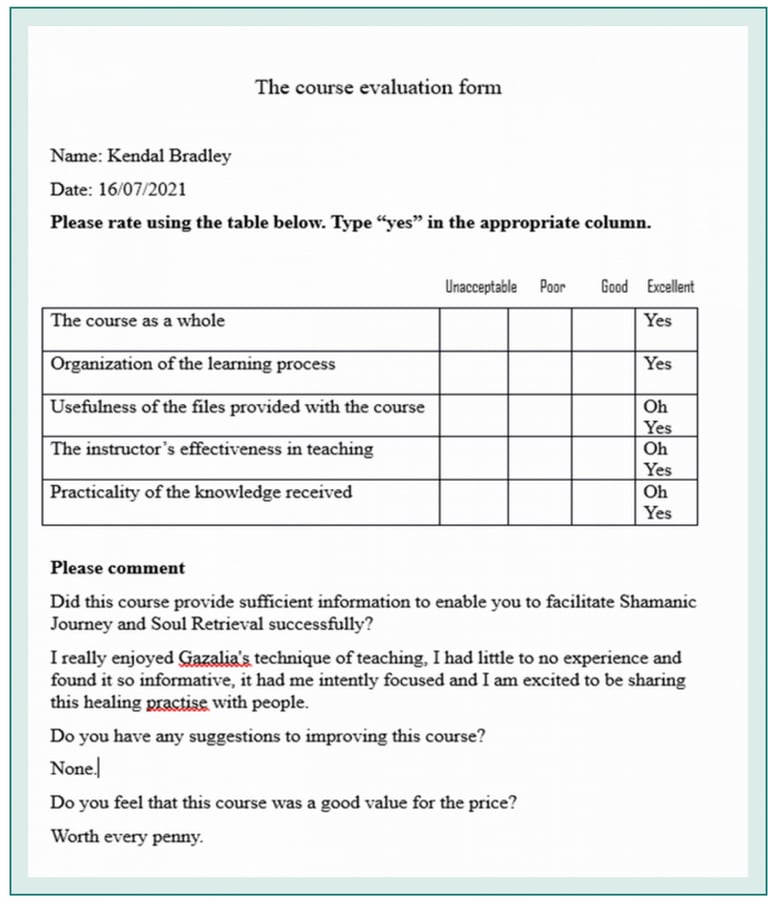
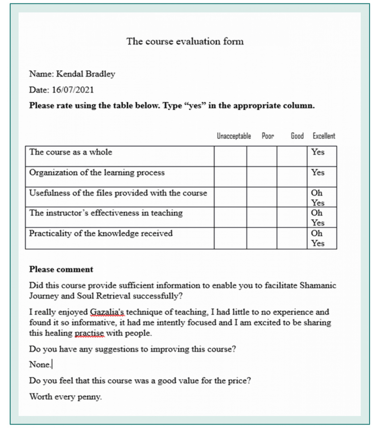
Evaluation of the course from our students


Regulations, Accreditation, and Licensing:
The regulations governing Shamanic or traditional healing methods and hypnosis practices vary across countries and within the USA, differing by state. Ensuring compliance with local business regulations is your responsibility. Presently in the USA, both hypnosis and healing operate as self-regulated professions without mandatory licensing.
Governmental bodies do not regulate or accredit shamanic or traditional healing modalities. Accreditation in the field of hypnosis, including institutions like the International Hypnosis School, lacks recognition from governmental bodies. Hypnosis, being self-regulated, doesn't demand formal diplomas or accreditations. Neither accreditation from Hypnosis Associations nor from educational bodies holds any weight.
Ultimately, the decision to pursue accreditation comes down to financial implications. The cost associated with accreditation is passed on to you, resulting in paying much more for something that adds no value. Can you imagine shelling out an extra $1000 for this course just for accreditation that essentially holds no real value?
My goal remains centered on delivering genuine knowledge drawn from real experiences. No fluff, just practical and valuable insights to help you thrive as a healer, enabling you to genuinely assist individuals and build a successful business in the real world.
I don't charge you $1,000 extra for a 'sticker' on your certificate that holds no legal weight. You are paying for knowledge and skill, not a piece of paper meant to impress people who don't understand the work.


This course will NOT teach you Native American Religion. Technically speaking, Native American Religion is not Shamanism. Shamanism and Native American Religion are NOT the same. Native American tribes don't even have the word "Shaman" in their language. Only a few Northern tribes practice Shamanism.
The word Shaman originated in the Tungus language, in Siberia. Shamanism is dated over 40,000 years ago - long before the existence of Native American tribes (26,000 years ago). Shamanism is practiced all over the world, on every continent, by every race, and by every nation.
Siberian Shamanism is believed to be the oldest form of Shamanism. Later, Shamanism was amalgamated with Islam and Buddhism but there are surviving traditions among the Siberian Tatars, Tuvans, and Tofalar. I am a Siberian Tatar.
Drawing from a rich ancestral lineage of healers, I can assure you that Shamanism is not a religious belief, an inherent gift, a mystical power transmitted through blood, or a supernatural ability; rather, it is a finely honed skill set. What may appear as a miraculous talent to some is, in reality, the product of countless lifetimes of dedication, extensive study, arduous effort, and unwavering commitment.
Knowledge is a treasure that is accessible to all who earnestly seek it. Your innate gifts and potential can be unlocked solely through the pursuit of knowledge and dedicated effort. No one will simply bestow these gifts upon you; they must be earned through diligence and perseverance.
Embrace your uniqueness, acknowledge your extraordinary gifts, and recognize your inherent power. These attributes are yours to claim, but they won't be handed to you. You are truly special, gifted, and powerful – now, it's time to take ownership of your potential and shine.
Will there be a chance to practice with peers the techniques taught?
Yes! Join our students' support group on Facebook and attend weekly live Zoom Meetups. You can exchange practice sessions with peers in our Facebook group.
Is there any support offered after the course?
Yes! I am available to you for further assistance. You can reach me by email or call. Join our Facebook group and attend weekly Zoom meetings for ongoing support.
What is the teacher's lineage?
Siberian.
What if I am aligned with a different lineage?
It does not matter. I am teaching techniques that can be implemented by anyone, even without any background in Shamanism. The protocol I have developed works even if you or your client don't believe in Shamanism. Look at it as a therapeutic tool.
Will this course help me to prepare for work with groups?
The protocols I share are suitable for working one-on-one, with groups, in the office setting, remotely online, or outside in nature. A set of three themed scripted workshops is included in the course's files. Download to your computer, type in your adjustments, print, and you will be ready to present to the public.
I am a hypnotherapist looking to implement Shamanic Soul Retrieval in my hypnotherapy practice.
This course will be perfect for you. The whole hypnotic protocol is outlined and hypnotic scripts are included ready for you to implement in your hypnosis sessions.
I don't have an office. Will I be able to offer this service online?
Absolutely! We are using hypnotic language. It doesn't matter whether you are sitting next to the client or working via Zoom or Skype. It's just as effective. You can build a successful business working from home without ever needing to rent an office. You can rent by the hour a larger space to run group events: yoga studio, conference room, classroom...
What is the earning potential for the skill you are teaching?
Depends on many factors: your local market, demand, and how proactive you are in promoting your services. For comparison, I charge $195-250 per 1-hour long private session and $35 - $45 per person for group events (in USA). I also get passive income from my audio recordings. I share all of it in the course and our Business Bootcamp: how to set up your business, how to promote it, how to create your own products and programs, and how to set up passive income streams.
What is the time commitment needed for studying this course?
Study at your pace. Some students feel confident in implementing learned skills in their work with clients quickly. They pass exams within just a few days. Some students take months. Although the course has lots of materials, not all materials are required for the study. There are some sections that are designed to help you start a business and promote your services. Live weekly classes are optional.
Can I practice Shamanism if I am religious?
Shamanism is not a religion. It's a skillset.
Will you be teaching Munay Ki Rites in this course?
No. A Tribe from a small Peruvian village does these rituals with the purpose of invoking and honoring THEIR Ancestors and THEIR Land Spirits. There is no benefit to you in invoking their Ancestors. They are not the ones that are watching over you. Be mindful when participating in rituals you know nothing of, you are opening yourself to foreign to you entities. You may get parasitic attachments or simply be drained of your energy and resources. Those who are selling you courses or ceremonies with Munay Ki Rites are either completely ignorant or con artists.
Why aren't teachings about the Medicine Wheel included in the curriculum?
The Medicine Wheel is a religious artifact designed to transmit cultural wisdom. Numerous Native American cultures have revered the Medicine Wheel as a sacred symbol, representing various facets of life, spirituality, and the interconnectedness of all things. It serves as a beautiful homage to the rich history and traditions these cultures cherish.
For those aspiring to become healers, it becomes imperative not to become entangled in the religion and religious artifacts that cannot contribute to one's skills and knowledge in the healing field. While the Medicine Wheel holds undeniable religious, cultural, and historical significance, it offers zero benefits when it comes to healing.
Isn't Shamanic Gift supposed to be handed down from our Ancestors?
Shamanism is not a 'gift', it's a skill set. Nothing is just given. There is no shortcut to knowledge, it takes studies and hard work. People who are telling you that this "gift" could only be passed by blood are, at its best, gullible, and at its worst, scammers. Run from those who tell you that they inherited a gift.
How can you charge money for traditional healing?
When did it become shameful to work for a living and provide for your family? Traditionally, a Shaman was supported and provided for by an entire Tribe. I assume that you don't have a Tribe providing for you and don't live off the Government's handouts. Have pride in earning a living. Unless someone starts to pay your bills and put food on your table, their input on whether you should charge for your work is irrelevant.
Real Shamans don't charge for healing.
I laugh at loud every time I hear that. I have lived in the USA since 2002, and am yet to see anyone offering healing for free.
My question is how do individuals who identify as genuine shamans, practicing healing without charging fees, manage to sustain themselves in a society where virtually everything comes at a cost, including housing, sustenance, education, healthcare, and utilities? Do they live off their mothers? Do they steal? Do they sell drugs? Do they depend on government assistance? Do they hold down additional jobs? I cannot imagine how I would do that while seeing clients every day from morning to night and teaching late at night and on weekends.
Isn't Shamanism exclusive to American Indian Culture?
Shamanism is not exclusive to American Indian culture. Its origins date back over 40,000 years, long before the first settlers arrived in North America approximately 26,000 years ago. Shamanism predates the existence of American Indian tribes, and it is a practice that has been embraced all over the world, across continents, by people of every race and nationality.
It's crucial to recognize the distinction between American Native Religion and Shamanism. While both hold unique cultural and historical significance, they serve different purposes, with American Native Religion primarily focusing on religious beliefs and rituals rather than the practical skills associated with Shamanism. While there may be overlaps in symbolism and spiritual concepts, the core distinction lies in the primary focus of Shamanism on healing and practical skillsets.
It's important to dispel the misconception that American Native Religion is synonymous with Shamanism. While the former centers on religious practices deeply intertwined with cultural identity, the latter is a distinct set of skills aimed at facilitating healing and personal growth.
How to tell a real Shaman from a fake?
Shamanism represents a natural response to the unique needs of a specific society during a particular moment in time. This is why it can take on diverse forms across different regions of the world. None of these variations is inherently superior to the others. Being different doesn't equate to being inauthentic. Shamanism serves as a reflection of the cultural evolution within a community.
Shamans can manifest in various appearances and roles within society. Some may appear as ordinary people, working in conventional office settings, while others may seem as if they belong to a bygone era, and still, others might be more eccentric and even resemble clowns in some aspects. Each of these manifestations serves a unique purpose and plays a vital role within their respective communities, highlighting the diverse ways in which shamanism is expressed and needed.
Personally, I want to see a real person with a real name and without any theatrical entourage, as costumes and trinkets are only needed when knowledge is lacking. People who point fingers and yell "fake" are usually the fake ones. Real healers do real work, they don't play dress-up, have no time to watch what others do, and have no need to sabotage others.
Real Shamans don't need certification:
Indeed, authentic Shamans do not need certification. However, based on my personal experience and insight, I prefer seeking guidance from individuals who have undergone formal training. This preference arises from the fact that they have invested time and effort into honing their skills, in contrast to those who simply declare themselves as shamans and recount tales of mystical "gifts" bestowed upon them in dreams or during drug-induced revelations.
Frequently Asked Questions
Shamanism vs. Native American Religion
A Fundamental Difference in Spiritual Agency
While both shamanism and Native American religion are deeply spiritual and often rooted in ancient traditions, they are not the same. It’s common to conflate them because many Indigenous cultures include both religious and shamanic elements, but at their core, the two represent very different relationships to the self, to power, and to the unseen world.
One of the most essential distinctions is this:
In shamanism, you take full responsibility for your life.
In religion, you give away your agency and appeal to higher beings for mercy or intervention.
Let’s explore that difference more deeply.
Shamanism - Direct Experience, Personal Power, and Inner Responsibility
Shamanism is not a belief system. It is a method, a practice, and a worldview. The shamanic path involves cultivating the skills to navigate non-ordinary reality for guidance, healing, and transformation. It assumes that the spiritual world is accessible, not just to priests or prophets, but to anyone with the discipline to explore it.
At its core, shamanism is about sovereignty.
You journey to the spirit world, not to worship, but to communicate, negotiate, and receive insight.
You meet allies, not deities, to co-create solutions, retrieve lost parts of your soul, or shift energy.
You do not give your power away. In fact, if you’re doing it right, you are constantly reclaiming your power, your intuition, your instincts, and your right to exist fully and freely.
Shamanism asks you to become aware of your inner wounds, your projections, and your patterns—not to escape them by handing them off to a god, but to integrate them. You are not a helpless sinner; you are a sovereign being learning to become whole.
In shamanism:
There is no worship.
There is no dogma.
There is only responsibility, relationship, and rhythm.
Native American Religion: Communal Faith, Sacred Narratives, and Reverence for the Great Spirit
Native American religion, on the other hand, often functions more like other traditional religions - rich with rituals, moral codes, sacred stories, deities, and spiritual hierarchies. While deeply tied to land and ancestors, and often respectful of nature, Native American religious practice varies from tribe to tribe and typically involves communal worship and reverence for spiritual forces considered more powerful than the individual.
In these systems, the spiritual world is something to be respected, feared, and appealed to. Spirits or deities are not peers or allies, but guardians, judges, or benefactors. Human beings are not seen as equal participants in the cosmic drama, but as children who must honor, obey, and plead.
Some common themes:
Prayers and offerings are made to external beings.
Power is often seen as outside the self.
Spiritual leaders (medicine men, ceremonial chiefs) may act as intermediaries between the people and the spirits.
This isn’t inherently negative. These religious systems have helped communities survive, connect, and pass on sacred knowledge for generations. However, they do rely on a structure that places divine authority outside the self.
The Difference in Agency - A Matter of Spiritual Maturity
The difference is not just philosophical, it is existential.
In religion, you are often at the mercy of forces larger than you. You may be told to wait, to repent, to suffer, to pray harder.
In shamanism, you are accountable. If something in your life is out of alignment, you seek the root cause, whether in your past, your ancestral line, your energy body, or your beliefs, and you work to transform it.
This is not always comfortable. It is easier, in some ways, to plead for divine grace than to face the truth of your own patterns. But the shamanic path offers something religion rarely does:
The power to change your life from the inside out.
Why This Distinction Matters Today
In today’s world, many are awakening to their spiritual gifts, but still approaching them through the lens of religious conditioning. They seek initiations, gurus, and holy figures to tell them what to do and how to be.
But the shamanic path calls differently. It whispers: You are the healer you've been waiting for.
This is not about appropriating Indigenous traditions or mimicking ceremonies out of context. It’s about reclaiming your direct relationship with Spirit, without middlemen, without hierarchy, and without surrendering your agency.
You are not here to beg the Universe for mercy.
You are here to walk into the dark, speak with your fears, reclaim your soul, and return with power.
In Conclusion
While shamanism and Native American religion both honor the unseen, their approaches to power are fundamentally different.
Religion externalizes spiritual authority.
Shamanism internalizes it.
Religion asks for forgiveness.
Shamanism demands integration.
Religion praises submission.
Shamanism calls for courage.
If you are ready to stop waiting for permission and start living with purpose, the shamanic path may be calling you, not to believe, but to remember who you truly are.
Need more information?
International Hypnosis School
Phone: 1(717) 753 8845
Pennsylvania, USA
@ 2019 hypnosis-training.online
Be the first to know when enrollment opens